
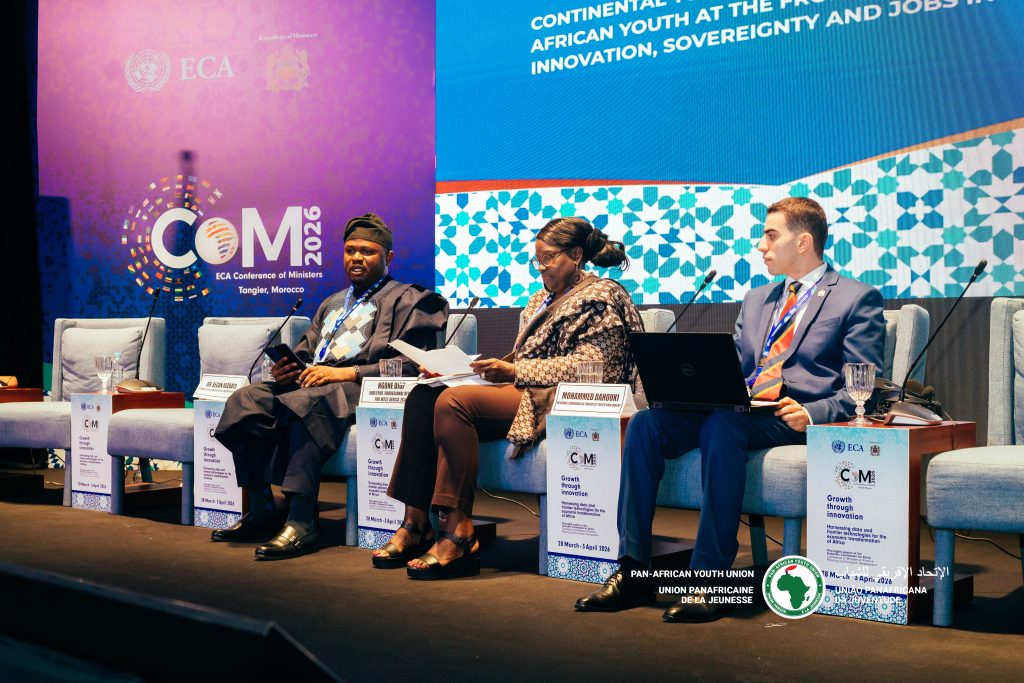
Tangier, Kingdom of Morocco Dr. Segun Adebayo, Executive Director of the Centre for African Policy Research and Advocacy (CAfPRA), has urged African governments to adopt self-preservation as a foundational strategy not only for digital sovereignty and data governance but for broader policy development across the continent.
Speaking as an expert panelist on “Digital Sovereignty, Data Governance and Africa’s Technological Autonomy” at the Continental Youth Symposium – a high-level side event held on the 31st of March, 2026 on the sidelines of the 58th Session of the United Nations Economic Commission for Africa (UNECA) Conference of African Ministers of Finance, Planning and Economic Development – Dr. Adebayo emphasized the need for deliberate, sovereign approaches to protect Africa’s interests in an increasingly competitive global landscape. The panel was moderated by Ngone Diop, Director, Sub-Regional Office for United Nations Economic Commission for Africa, West Africa.
The symposium, convened by the Pan-African Youth Union in collaboration with UNECA, brought together young African leaders to discuss technologies, innovation, sovereignty, and jobs in the digital age, against the backdrop of the main ministerial conference themed “Growth through innovation: harnessing data and frontier technologies for the economic transformation of Africa.”
Dr. Adebayo, opened his remarks by stressing the importance of strategy in Africa’s engagement with global digital dynamics. “Two football teams may come together with the same number of players, the same coaches, well-trained personnel and substantial resources, yet one defeats the other 5-0. The difference lies in strategy,” he said. “What is our strategy in Africa? Knowing our heritage and the important role we play in the world today, what is our strategy in managing and governing our data?”
He proposed self-preservation as the guiding doctrine for African policy formulation. “Self-preservation is an existential act of ensuring that you survive against all odds,” Dr. Adebayo explained. He drew parallels with actions taken by major global powers, including the United States’ measures on platforms like TikTok to prevent sensitive citizen data from flowing to foreign adversaries, and Iran’s actions in the Strait of Hormuz as clear demonstrations of self-preservation in the face of external pressures.
“Africa must begin to develop policies of self-preservation, starting with our data,” he asserted. He questioned the current location of Africa’s data, noting the limited presence of major international tech firms’ data centres on the continent and highlighting concerns over data residency. “Data is the best natural resource you could ever find,” he added.
Citing a recent bilateral tax agreement between Nigeria’s tax authority and France, Dr. Adebayo warned of the risks of ceding control over critical economic information. “We could see that the country was handing over the economic dashboard to another country… You cannot afford to have tensions with those to whom you give your data, because they know everything about you.”
He extended the principle of self-preservation beyond digital issues, positioning it as a comprehensive framework to guide policy development in economic, technological, and strategic domains, ensuring Africa safeguards its interests amid global power dynamics.
Urgent Call for Curriculum Reform and Policy Education
Dr. Adebayo linked self-preservation to the transformation of Africa’s education systems, advocating for a fundamental shift in curricula to align formal education directly with job-readiness and continental priorities.
“Why must we go through formal education only to pursue additional job-ready training afterwards? Why can’t we convert formal education into job-readiness education by changing our curricula in Africa once and for all?” he asked. “This is the first step towards playing effectively in the global space.”
He argued that education must actively support self-preservation policies, equipping graduates with the skills and mindset needed for technological autonomy and economic resilience.
On the question of balancing self-preservation with the creation of digital jobs for Africa’s youth in a context of high unemployment, Dr. Adebayo maintained there is no inherent conflict. He noted that technology naturally aligns with young people and highlighted Nigeria’s vibrant youth-led tech ecosystem, including Flutterwave – one of Africa’s largest startups, valued at over $3 billion – alongside other successful platforms such as Paystack, Bamboo, and DigiVest, pioneered largely by individuals under 40.
He pointed to growing youth representation in governance, including young ministers in their 30s and early 40s, a 26-year-old lawmaker, and a dedicated “Youth in Parliament” committee comprising over 40 members in Nigeria. CAfPRA provides policy consultation to this committee.
The critical bridge, according to Dr. Adebayo, is policy education. He observed that frameworks such as Africa’s Agenda 2063 often receive far less attention in government ministries than the UN Sustainable Development Goals.
“Policy education is one of the biggest challenges in policy adoption,” he said. “If young people are well-oriented on the advantages and risks of policies governing data usage, data storage, investment in continental data centres, and the treatment of human capital as a form of defence, they will assume leadership in these areas.”
He called on governments, the media, policy research organisations, multilateral bodies, and intergovernmental institutions to elevate these discussions until they achieve widespread awareness and top-of-mind priority among Africa’s youth.
Dr. Segun Adebayo’s first major call for data sovereignty in policy making was at the National Youth Dialogue on Tax Reforms in March 2025, where he argued that Nigeria’s pivot to an identity-based tax system should be driven by local technology players, warning on the dangers of losing this to foreign interests who had shown interest in the data, and were guiding the policy development process. He further stressed the need for tighter data security at the press briefing in the Senate pressroom, where he argued that Nigeria’s data protection act lacked sufficient protection of GPS location and financial information, which could be exploited if our data gets into the wrong hands and creates problems in national security. In a letter to the President by the Northern Elders Forum to terminate the FIRS + France MOU on tax reforms, Dr Segun’s call was noted as an ignored warning, making it a port of entry of foreign entities into our economic bloodstream. According to the Forum, surrendering control of tax data exposes the country to economic espionage, mass surveillance and potential geopolitical blackmail, as foreign actors could gain insight into Nigeria’s strategic sectors, revenue flows and investment patterns, adding that, “No serious country hands such power to another state.”
Taking his call for data independence to UNECA’s Conference of Ministers, Adebayo pushes that Africa must move from reactive engagement to proactive self-preservation in data governance, digital strategy, education reform, and broader policy architecture to secure its technological autonomy and economic future in the digital age.